
12 Skills: Where People Shine and Where AI Helps
Part 1 of 2 in the Using AI Well series. Part 2 turns these skills into a practical playbook for working with AI.
I work in site reliability engineering and AI now shows up in more of my daily work. That raised a question: When I make a good decision, what am I actually doing that AI isn’t?
Much of the public conversation frames this as humans versus AI. I think that’s the wrong question.
AI is a tool, and the useful questions are where it adds the most value and which skills we should sharpen ourselves.
David Hume put it well in 1739: “Reason is, and ought only to be the slave of the passions.” Deciding what matters is still our job.
It turns out there are twelve skills behind good judgment, and we use them far beyond big decisions: when we diagnose a problem, plan, learn something new, prioritize, review someone’s work, explain an idea or work with people, to name a few. Mostly, we use them without noticing.
Philosophers have been describing them for 2,400 years, but you don’t need the philosophy to use them. Below are the twelve skills, how people and AI compare on each, where the skills show up in everyday work and, for the curious, where the ideas come from.
The 12 skills: where each one helps, and where it slips
Section titled “The 12 skills: where each one helps, and where it slips”These 12 skills are the building blocks of judgment work. Decisions are where they all come together, but each one shows up in everyday work too.
Probability is only one lens among them. AI models learn from statistical patterns in data, which makes them strong at some and weak at others. Neither people nor their tools are reliably good at all twelve.
Here is where each tends to be strong and where each tends to slip, based on the research listed at the end of this post.
| Skill | Humans | AI today |
|---|---|---|
| Causal reasoning ”If I do X, Y will happen, because…” | Mixed. Can test causes by trying things, but overrate how well they understand how things work | Mixed. Fine on well-known causes, weak at inferring new ones from data |
| Logic and consistency Checking that an argument holds together | Mixed. Reason better when a problem matches their experience, but seek evidence that confirms their view, not tests it | Moderate, improving. Tripped up by irrelevant details or rewording |
| Pattern recognition ”This looks like that incident last year.” | Strong with fast, regular feedback (expert intuition), but see patterns in noise without it | Strong, but can invent patterns from thin data |
| Heuristics Rules of thumb, like “avoid single points of failure” | Strong. Simple rules often work as well as complex models, but bring predictable biases | Strong at proposing rules and checklists |
| Analogy Applying what worked in one situation to a new one | Mixed. Find deep analogies once prompted, but often miss them otherwise | Strong on familiar problems, brittle on unfamiliar ones |
| Domain expertise Knowing how things fail, from hands-on experience | Strong. Hands-on, tacit knowledge of how things fail, but slow to build and can harden into rigidity | Mixed. Very broad book knowledge, no hands-on experience |
| Values and ethics ”Even if it works, should we do it?” | Strong on stakes and accountability, but often decide by gut feeling, then rationalize | Weak. No personal stakes; answers can shift with phrasing |
| Goal-setting Deciding what matters before deciding what is likely | Strong at deciding what should matter, but can pick narrow goals that backfire | Weak at deciding what should matter |
| Systems thinking Seeing dependencies, feedback loops and side effects | Mixed. Know unwritten local constraints, but have poor intuition for feedback loops and delays | Mixed. Maps systems well, misses unstated constraints |
| Counterfactual thinking ”What would happen if we didn’t do this?” | Mixed. Can test “what ifs” in the real world, but hindsight makes the past look predictable | Weak at verification. Generates “what ifs” it can’t test |
| Metacognition Noticing your own biases: “What would change my mind?” | Mixed. Can correct for bias by deliberately considering the opposite, but miss their own and overrate weak skills | Weak at catching its own errors without outside checks |
| Social reasoning Reading incentives, trust and group dynamics | Strong. Read tone and body language quickly, but blame personality and overlook the situation | Mixed. Good on many theory-of-mind tests, brittle on variations, no tone or body language |
“AI” here means general-purpose language models such as ChatGPT, Claude and Gemini, as of 2026. Ratings in both columns are rough judgments drawn from the research and ideas in this post, not scores. AI capabilities change quickly, so treat the right-hand column as a snapshot.
The takeaway
Section titled “The takeaway”The point isn’t that humans win, or that AI does. It’s that people and their tools are strong in different places.
That difference is exactly what makes them useful together, as long as you know which to rely on for what.
That’s the subject of Part 2: Sharpen, Delegate, Partner, which turns these twelve skills into a practical playbook, with examples from SRE work.
Where these skills show up
Section titled “Where these skills show up”Decisions are only one place these skills matter. Here are some of the kinds of work that draw on them, and the skills each leans on most.
| Activity | Skills it draws on |
|---|---|
| Diagnosing a problem | Causal reasoning, pattern recognition, counterfactual thinking |
| Planning | Goal-setting, systems thinking, heuristics |
| Learning something new | Analogy, metacognition, pattern recognition |
| Designing and building | Systems thinking, heuristics, domain expertise, causal reasoning |
| Prioritizing | Goal-setting, values and ethics, counterfactual thinking |
| Assessing risk and forecasting | Counterfactual thinking, systems thinking, pattern recognition |
| Reviewing someone’s work | Logic and consistency, domain expertise, metacognition |
| Explaining an idea | Analogy, logic and consistency |
| Research and investigation | Causal reasoning, logic and consistency, metacognition |
| Creative problem-solving | Analogy, counterfactual thinking |
| Negotiating, teaching and mentoring | Social reasoning, analogy, values and ethics |
| Working with people | Social reasoning, values and ethics |
Curious where these twelve skills come from? The rest of this post traces them back through 2,400 years of philosophy.
Where these skills come from
Section titled “Where these skills come from”Thinkers from ancient Athens to medieval Baghdad and Cairo, and on to modern Europe and America, kept arriving at the same five ideas, often centuries apart. Each one supports some of the skills above.
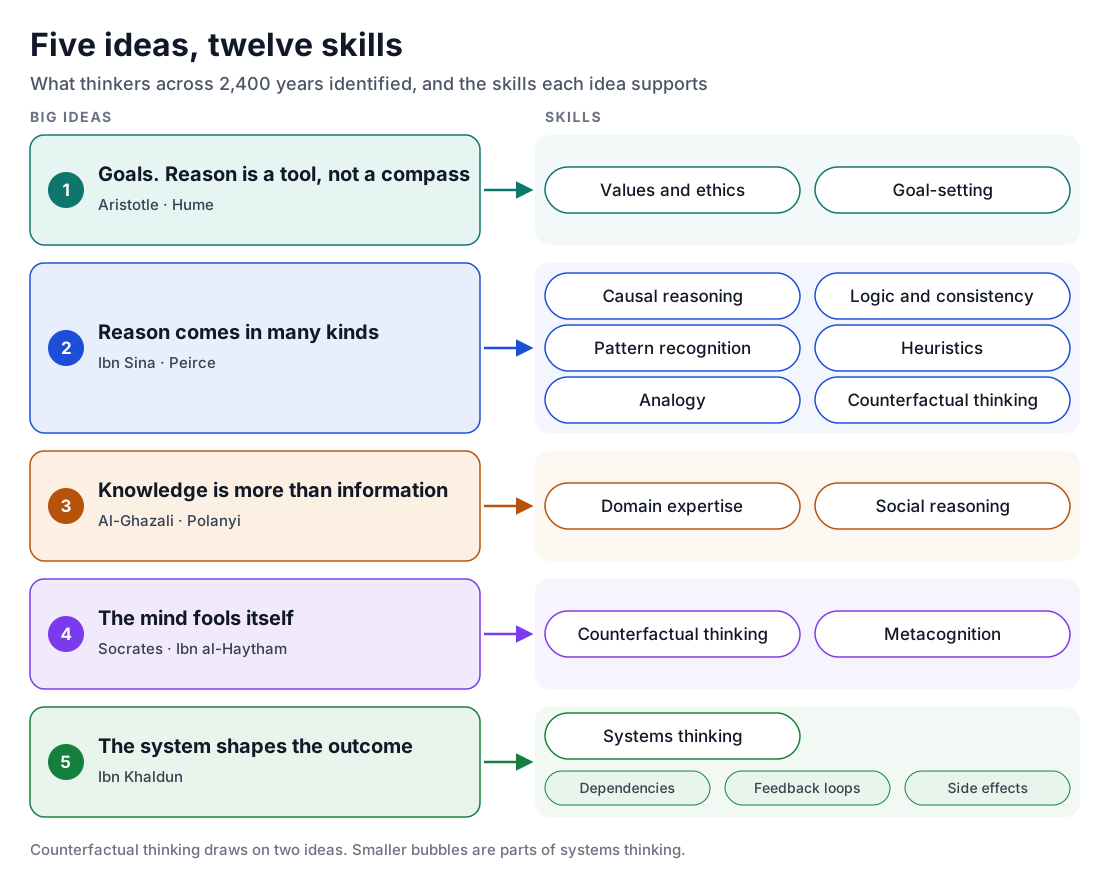
Five ideas, and the skills each one supports.
1. Goals. Reason is a tool, not a compass
Section titled “1. Goals. Reason is a tool, not a compass”Before any reasoning starts, someone has to decide where to go. Reasoning can tell you how to get there; it can’t choose the destination.
- Aristotle (4th century BCE) called the skill of judging what is good, and acting well on it in real situations, practical wisdom. He saw it as different from cleverness.
- David Hume (1739), quoted at the top of this post, put it bluntly: “Reason is, and ought only to be the slave of the passions.” Goals come from what we care about, not from logic.
Skills it supports: values and ethics, goal-setting.
2. Reason comes in many kinds
Section titled “2. Reason comes in many kinds”There is no single “reasoning engine.” Different problems call for different kinds of thinking.
- Ibn Sina (11th century) described intuition as the ability to grasp the missing link in an argument instantly, without working through each step. He noted that people differ greatly in it, an early account of expert pattern recognition.
- Charles Sanders Peirce (19th century) named three modes of inference: deduction (applying rules), induction (generalizing from examples) and abduction (guessing the best explanation).
Skills it supports: causal reasoning, logic and consistency, pattern recognition, heuristics, analogy, counterfactual thinking.
3. Knowledge is more than information
Section titled “3. Knowledge is more than information”Knowing a fact, knowing how to do something and knowing a person are different kinds of knowledge.
- Al-Ghazali (11th century) pointed out that knowing the definition of something is not the same as experiencing it, just as knowing the definition of intoxication is not the same as being intoxicated.
- Michael Polanyi (1966) made the same point in modern terms: “we know more than we can tell.” Much of what experts know can’t be fully written down.
Skills it supports: domain expertise, social reasoning.
4. The mind fools itself
Section titled “4. The mind fools itself”Good thinkers build in ways to catch it.
- Socrates taught that wisdom begins with knowing what you don’t know.
- Ibn al-Haytham (11th century), a pioneer of experimental science, argued that anyone seeking the truth should challenge everything they read, and suspect their own judgment too.
Skills it supports: metacognition, counterfactual thinking.
5. The system shapes the outcome
Section titled “5. The system shapes the outcome”- Ibn Khaldun (1377) explained the rise and fall of dynasties as a cycle: group cohesion builds power, power brings comfort, comfort erodes cohesion. It is a feedback-loop model of whole societies, written centuries before “systems thinking” had a name.
Skills it supports: systems thinking.
Sidebar: what is a cause? One question runs from the 11th century straight into today’s AI research.
- Al-Ghazali (c. 1095): when fire touches cotton and the cotton burns, we only observe the two happening together. We never observe a necessary link between them.
- Hume (1740s): made a strikingly similar argument. We see one event follow another, and our minds supply the connection out of habit.
- Judea Pearl (2018): described a “ladder” of causal thinking: seeing patterns, doing (predicting the effect of an action) and imagining what would have happened otherwise. He argued that most machine learning is stuck on the first rung.
Telling real causes apart from things that merely happen together is still one of the hardest problems for AI.
Sources and further reading
Section titled “Sources and further reading”Thinkers in this post
Section titled “Thinkers in this post”- Al-Ghazali, Deliverance from Error; The Incoherence of the Philosophers. Stanford Encyclopedia of Philosophy (SEP) overview
- Michael Polanyi, The Tacit Dimension (1966)
- Ibn Sina (Avicenna), on intuition. SEP overview
- Charles Sanders Peirce, on deduction, induction and abduction. SEP, “Abduction”
- Aristotle, Nicomachean Ethics, Book VI. SEP, “Aristotle’s Ethics”
- David Hume, A Treatise of Human Nature; An Enquiry Concerning Human Understanding. SEP overview
- Ibn al-Haytham, Book of Optics; Doubts Concerning Ptolemy. Britannica overview
- Ibn Khaldun, The Muqaddimah (1377). Britannica overview
- Judea Pearl & Dana Mackenzie, The Book of Why (2018). Author’s page
Want to go deeper?
Section titled “Want to go deeper?”These thinkers explored the same ideas and are worth reading next:
- Al-Farabi, who treated logic as the grammar of reason. SEP
- Ibn Rushd (Averroes), who defended real causes against al-Ghazali. SEP
- Suhrawardi and Mulla Sadra, on direct versus acquired knowledge. SEP: Suhrawardi, SEP: Mulla Sadra
- Francis Bacon, whose “Idols of the Mind” were an early catalog of biases. SEP
- John Dewey, How We Think (1910). SEP
- Herbert Simon, on “good enough” decision-making. SEP, “Bounded Rationality”
- David Lewis, Counterfactuals (1973). SEP
- Hubert Dreyfus, What Computers Can’t Do (1972)
Research behind the comparison table
Section titled “Research behind the comparison table”Humans
- Ambady & Rosenthal (1992), accurate judgments from brief glimpses of behavior. doi:10.1037/0033-2909.111.2.256
- Fischhoff (1975), hindsight bias. doi:10.1037/0096-1523.1.3.288
- Gick & Holyoak (1980), analogies missed, then found with a hint. doi:10.1016/0010-0285(80)90013-4
- Gigerenzer & Gaissmaier (2011), when heuristics work. doi:10.1146/annurev-psych-120709-145346
- Gilbert & Malone (1995), blaming personality over situation. doi:10.1037/0033-2909.117.1.21
- Griggs & Cox (1982), logic improves when problems match experience. doi:10.1111/j.2044-8295.1982.tb01823.x
- Haidt (2001), gut-first moral judgment. doi:10.1037/0033-295X.108.4.814
- Kahneman & Klein (2009), when intuition can be trusted. doi:10.1037/a0016755
- Kruger & Dunning (1999), overconfidence. doi:10.1037/0022-3514.77.6.1121
- Lord, Lepper & Preston (1984), considering the opposite reduces bias. doi:10.1037/0022-3514.47.6.1231
- Ordóñez et al. (2009), goals that backfire. doi:10.5465/amp.2009.37007999
- Pronin, Lin & Ross (2002), the bias blind spot. doi:10.1177/0146167202286008
- Rozenblit & Keil (2002), the illusion of understanding. doi:10.1207/s15516709cog2605_1
- Sterman (1989), misreading feedback loops. doi:10.1287/mnsc.35.3.321
- Tversky & Kahneman (1974), heuristics and biases. doi:10.1126/science.185.4157.1124
- Wason (1968), confirmation-seeking. doi:10.1080/14640746808400161
AI
- Huang et al. (2023), self-correction. arXiv:2310.01798
- Jin et al. (2023), causation from correlation. arXiv:2306.05836
- Kadavath et al. (2022), calibration. arXiv:2207.05221
- Kıcıman et al. (2023), causal reasoning. arXiv:2305.00050
- Lewis & Mitchell (2024), analogy on unfamiliar problems. arXiv:2402.08955
- Mirzadeh et al. (2024), sensitivity to rewording. arXiv:2410.05229
- Scherrer et al. (2023), moral judgments in LLMs. arXiv:2307.14324
- Strachan et al. (2024), theory of mind. doi:10.1038/s41562-024-01882-z
- Ullman (2023), small changes break theory of mind. arXiv:2302.08399
- Webb, Holyoak & Lu (2023), analogical reasoning. doi:10.1038/s41562-023-01659-w